
How to Lose Weight Working an Office Job (Without Losing Your Mind)
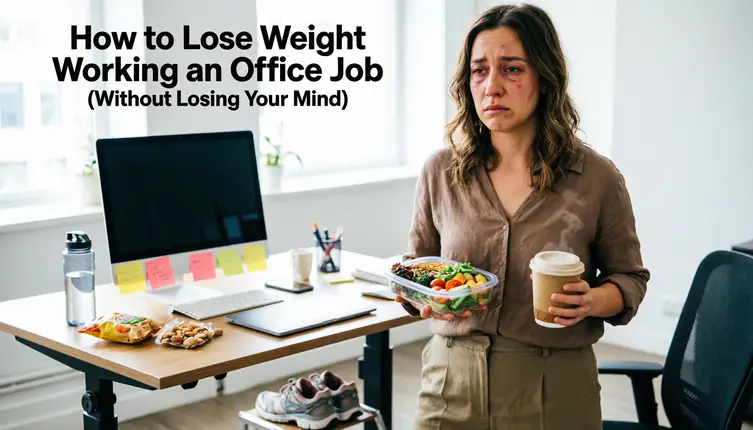
How to Lose Weight Working an Office Job (Without Losing Your Mind)
You’re not lazy. You’re not unmotivated. You’re just sitting in a chair for eight or nine hours a day in a system that was never designed to keep you healthy.
I didn’t connect the dots until I stepped on a scale after about eighteen months at my first desk job. I hadn’t changed what I was eating — not dramatically, anyway — but I’d put on close to twenty pounds. I was tired all the time, weirdly bloated, and my afternoon coffee wasn’t cutting it anymore. It wasn’t until I started actually paying attention to how little I moved, how often I stress-ate, and how my whole lifestyle had quietly shifted that things started to make sense.
If you’re trying to figure out how to lose weight working an office job, this is for you. Not the version that tells you to wake up at 5 AM and do CrossFit. The real version — for real people who have jobs, deadlines, and sometimes eat a granola bar for lunch because that was the only option.
Why Office Jobs Cause Weight Gain (And Why It’s Not Your Fault)
The Movement Problem Nobody Talks About
Office job weight gain doesn’t usually happen because you started eating more. It happens because you stopped moving — almost entirely — without noticing.
Think about it. You commute (probably sitting). You work (sitting). You eat lunch (sitting). You drive home (sitting). You decompress on the couch (sitting). By the time the day is over, some people have taken fewer than 2,000 steps. For context, the general recommendation is around 7,000–10,000.
A sedentary lifestyle weight gain pattern is sneaky because your appetite doesn’t always adjust to match your activity level. Your body expects to feel hunger at certain times, and it doesn’t automatically eat less just because you moved less. So you end up consuming close to the same number of calories while burning significantly fewer — and over weeks and months, that gap adds up fast.
Stress, Cortisol, and the 3 PM Cookie
Desk jobs aren’t just sedentary — they’re mentally exhausting in a way that messes with your hormones. Chronic stress keeps cortisol levels elevated, and elevated cortisol does a few things that make desk job fat loss genuinely harder:
- It increases cravings for high-calorie, high-sugar foods
- It promotes fat storage, particularly around the belly
- It disrupts sleep, which further impacts hunger hormones
- It drains your willpower, making it harder to make intentional food choices
By 3 PM on a hard workday, your brain has made thousands of small decisions. It’s tired. And that’s exactly when the office kitchen becomes a problem.
Convenience Culture at the Office
The foods closest to you at work are almost never the foods you’d choose if you planned ahead. Vending machines, gas station runs, birthday cake in the break room, catered lunch meetings full of white bread and pasta — office lifestyle weight loss has to account for the food environment you’re actually in, not some idealized version of it.
The Hidden Habits That Are Making It Worse
Mindless Snacking While Working
When you’re deep in a task, eating becomes automatic. You’re not thinking about hunger — you’re thinking about the spreadsheet — and somehow you’ve eaten half a bag of trail mix without registering any of it. This is one of the biggest drivers of office job weight gain and one of the hardest to address because it’s so unconscious.
Liquid Calories You’re Not Counting
That morning latte with two pumps of vanilla. The afternoon vending machine sweet tea. The kombucha that sounds healthy. Calories in drinks add up quietly, and most people dramatically underestimate how much they’re consuming through beverages alone. Some specialty coffee drinks clock in at 400–500 calories — nearly a quarter of a day’s intake before 9 AM.
The Exhaustion Cycle
Here’s one people don’t talk about enough: sitting all day weight gain is partly driven by exhaustion. You sit, your energy crashes, you eat sugar to compensate, your energy crashes again, you skip the gym because you’re wiped, you sleep poorly, and you wake up already behind. Repeat for twelve months.
Breaking that cycle is less about discipline and more about understanding what’s actually happening physiologically.
Simple Ways to Lose Weight With a Desk Job
1. Walking Breaks — Small But Powerful
Walking breaks for weight loss are probably the single most underrated tool for office workers. You don’t need to go to the gym. You don’t need workout clothes. You just need to stand up and walk.
Research consistently shows that breaking up long periods of sitting — even with short 2–5 minute walks — improves blood sugar regulation, boosts metabolism, and reduces some of the hormonal damage caused by prolonged sitting.
Try this:
- Walk to get water every hour (bonus: you drink more water)
- Take calls on foot whenever possible
- Set a phone alarm every 60–90 minutes as a movement reminder
- Use the bathroom on a different floor
None of these are life-changing on their own. Combined over 8 hours, 5 days a week? They start to matter.
2. Protein-Forward Eating
The most effective shift most desk workers can make is increasing protein intake. Protein keeps you fuller longer, reduces mindless snacking, supports muscle mass during calorie deficit, and has a higher thermic effect — meaning your body actually burns more calories digesting it compared to carbs or fat.
Low calorie office lunches built around protein look like:
- Grilled chicken or turkey on greens with olive oil
- Greek yogurt with berries (plain, not the sweetened kind)
- Cottage cheese with cucumber and everything bagel seasoning
- Hard-boiled eggs and raw veggies
- Tuna or salmon packets with crackers
None of these require a microwave, extensive prep, or anything impressive. They’re just reliable.
3. Meal Prep for Office Workers — But Make It Realistic
Nobody wants to spend three hours cooking on a Sunday night. But meal prep for office workers doesn’t have to be that. It can be:
- Washing and cutting vegetables while something else is cooking
- Making a big batch of rice or quinoa once a week
- Portioning out snacks into individual bags so you grab the right amount
- Cooking two or three proteins that work across multiple meals
The goal isn’t Instagram-worthy containers. The goal is having something better than vending machine chips when you’re hungry at 2 PM.
4. Fix Your Coffee Habit
This one hurts a little. A plain black coffee has about 5 calories. A medium vanilla latte with oat milk has somewhere between 200–350 depending on the size and shop. If you’re getting two of those a day, that’s 400–700 liquid calories — possibly more — that aren’t doing anything for your hunger.
Healthy office habits around coffee don’t mean drinking it black forever. But maybe it means:
- One fancy coffee in the morning, black or with a splash of regular milk in the afternoon
- Swapping afternoon sweet drinks for sparkling water or herbal tea
- Trying a smaller size
It’s not about perfection. It’s about becoming aware of where the extra calories are quietly hiding.
5. Hydration as a Weight Loss Tool
Most desk workers are mildly dehydrated for most of the day. Mild dehydration mimics hunger, which means you eat when you actually just need water. Keeping a large water bottle at your desk and drinking consistently throughout the day is one of the cheapest, simplest fat burning habits at work you can build.
Aim for at least half your bodyweight in ounces, more if you’re in a warm office or drink a lot of caffeine.
6. Standing More (Without Going Overboard)
Standing desks have a bit of a hype problem — standing all day isn’t dramatically better than sitting all day. But alternating between sitting and standing throughout the day, along with the short walks mentioned above, does meaningfully reduce the health risks of prolonged sitting.
If you don’t have a standing desk, a monitor riser and a stack of books can create a makeshift version for free. Even standing for 15–20 minutes per hour adds up.
Best Healthy Office Snacks for Weight Loss
Healthy office snacks aren’t complicated, but they do need to be intentional. Here’s what works:
High-protein options:
- String cheese
- Beef jerky (low-sodium when possible)
- Hard-boiled eggs
- Edamame
- Roasted chickpeas
Lower-calorie, filling options:
- Baby carrots and hummus
- Apple slices with peanut butter (single-serve packets)
- Rice cakes with avocado
- Cherry tomatoes and mozzarella
What to avoid keeping at your desk:
- Chips, crackers, or anything you can eat straight from a large bag
- Candy dishes (just move them)
- Sweet granola bars disguised as health food
The real rule: if it lives on your desk, you’ll eat it mindlessly. Keep the healthy stuff visible and accessible; keep everything else out of arm’s reach.
Easy Office Exercises (That Don’t Require Changing Clothes)
Simple office workouts don’t have to be awkward. You don’t have to do push-ups in the conference room (though some people do, and respect to them).
At Your Desk
- Seated leg raises: Straighten one leg, hold for a few seconds, lower. Repeat.
- Chair squats: Stand up from your chair slowly, hover just above the seat, sit back down. Do 10.
- Desk push-ups: Hands on the edge of the desk, lean in and push back. Good for posture and upper body.
- Calf raises: Stand behind your chair, rise onto your toes, lower. Do it while you’re on hold.
Around the Office
- Take the stairs instead of the elevator — every single time
- Walk to a colleague’s desk instead of sending a Slack message
- Pace during phone calls
- Suggest walking meetings for 1-on-1s
Resistance Bands at Your Desk
A small resistance band is cheap, fits in a drawer, and lets you do seated rows, bicep curls, and shoulder exercises without standing up. If you work from home, even better — you have more privacy to actually use it.
Realistic Habits That Actually Work for Easy Weight Loss for Busy Professionals
Here’s the honest part: most of us aren’t going to overhaul our entire lifestyle. Extreme diets don’t survive contact with a stressful workweek. What does survive is tiny, boring, consistent habits.
- Eat before you’re starving. Waiting until you’re ravenous guarantees a bad choice.
- Don’t skip breakfast to save calories. It usually backfires by 11 AM.
- Plan your lunch the night before. Not the whole week — just tomorrow.
- Sleep is non-negotiable. Poor sleep increases ghrelin (hunger hormone) and decreases leptin (fullness hormone). You cannot out-discipline bad sleep.
- Track for awareness, not punishment. Using a food log for even a week usually reveals patterns you didn’t know existed.
How to stay fit working in an office isn’t about finding perfect conditions. It’s about making slightly better choices in imperfect conditions, consistently, over time.
FAQ: Losing Weight at an Office Job
Can you lose weight with an office job? Absolutely yes. It requires more intention than a physically active job, but it’s completely achievable with realistic habit changes — better food choices, more movement throughout the day, and improved sleep.
What causes office weight gain? A combination of low daily movement, stress eating, elevated cortisol from chronic work stress, high-calorie convenience foods, and sedentary habits both at and after work.
How many calories do desk workers burn? A sedentary desk worker burns roughly 1,600–2,000 calories per day depending on body size, age, and activity level — significantly less than someone with a physically active job. This is why food choices matter so much.
What are the best snacks for office workers trying to lose weight? High-protein, lower-calorie options work best: Greek yogurt, hard-boiled eggs, string cheese, roasted chickpeas, baby carrots with hummus. These keep blood sugar stable and reduce the afternoon energy crash.
How do office workers stay fit? Consistent small habits — walking breaks every hour, protein-focused meals, limited liquid calories, simple desk exercises, and prioritizing sleep — matter more than occasional intense gym sessions.
How many steps should office workers aim for daily? 7,000–10,000 steps is a solid general target. If you’re currently at 2,000, start by adding 1,000 extra steps per day and build from there. Don’t try to jump from barely moving to 10K overnight.
Does sitting all day slow your metabolism? Yes, prolonged sitting reduces metabolic rate and impairs blood sugar regulation. Breaking up sitting with short movement breaks throughout the day meaningfully counteracts these effects.
Conclusion: The Office Isn’t Working Against You — But You Have to Work With It
How to lose weight working an office job isn’t a mystery, but it does require working around some real obstacles. The job, the stress, the food environment, the exhaustion — those are all real. You’re not imagining any of it.
But none of it is insurmountable. Most of the strategies in this article cost nothing. They don’t require a gym membership, a meal delivery service, or two hours of free time you don’t have. They require noticing your patterns, making a few small shifts, and giving those shifts time to compound.
Start with one thing this week. Maybe it’s a walk after lunch. Maybe it’s switching your afternoon snack. Maybe it’s drinking a glass of water before every meal. Small, consistent, and imperfect beats dramatic, exhausting, and temporary every single time.
You’ve got this — even from a desk.
Found this helpful? Save it to Pinterest and share it with a coworker who might need it too.

Food lover and creator of BestCarbRecipes, sharing easy recipes, low-carb meal ideas, healthy cooking inspiration, calorie-friendly tips, and practical food guides to make everyday eating simpler, healthier, and more delicious.